Intro
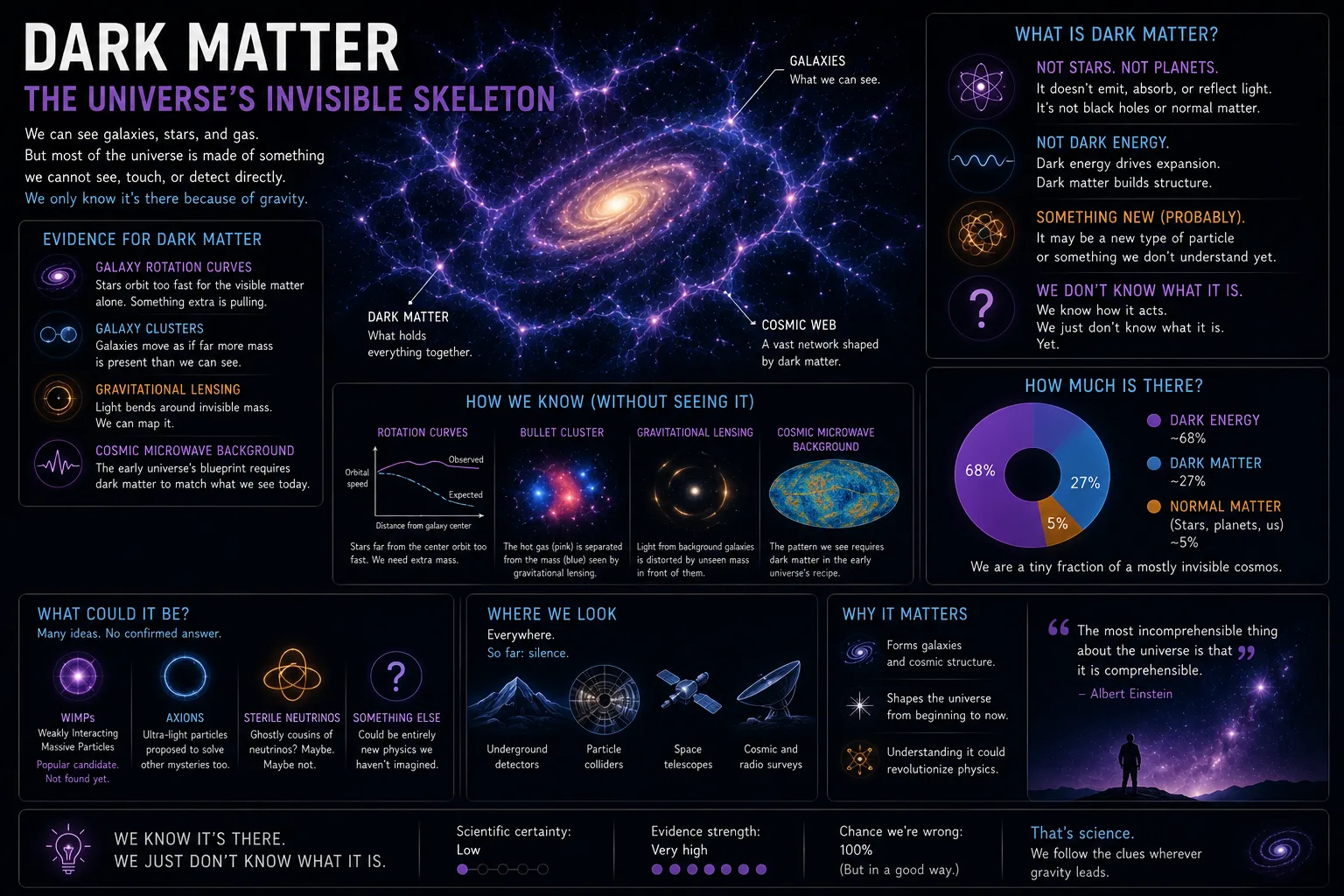
You can see galaxies, stars, and gas. But add up everything that gives off, absorbs, or reflects light, and you only account for a small fraction of the matter that must be there. The rest is dark: it does not shine, and nothing we have built has ever touched it. We know it exists only because of how its gravity shapes everything else.
What We Know
The evidence is not one clever observation. It is several independent ones that agree.
- Galaxy rotation curves. Stars at the edges of galaxies orbit far too fast for the visible mass to hold them in. Something extra is pulling.
- Gravitational lensing. Light from distant galaxies bends around mass we cannot see, letting us map the hidden scaffolding directly.
- The Bullet Cluster. When two galaxy clusters collided, the visible gas slowed down but most of the mass, traced by lensing, sailed straight through, separated from the matter we can see.
- The cosmic microwave background. The early universe’s blueprint, measured precisely by ESA’s Planck, only matches what we observe if dark matter is part of the recipe, at roughly 27% of the universe.
What We Think
The leading idea is that dark matter is a new kind of particle that barely interacts with ordinary matter. Candidates include WIMPs (weakly interacting massive particles), axions, and sterile neutrinos. Each is motivated, and none has been confirmed.
What We Do Not Know
We do not know what dark matter is. Decades of underground detectors, particle colliders, and sky surveys have not caught it. A minority view holds that the discrepancy is instead a sign that we misunderstand gravity on large scales, though that struggles to explain all the evidence at once.
Why It Matters
If most of the matter in the universe is something we have never identified, our inventory of reality is badly incomplete. Whatever dark matter turns out to be, finding it would be a discovery on the scale of a new chapter of physics.